A book for recovering useful people
"A process for questioning your own misery and wondering how you can pull back."


I did not anticipate feeling as seen and shaken as I did by L.A.-based witch Priyanka Mattoo's new memoir How to Be Less Useful: The Joy of Inefficiency. I think I was expecting something like a jokey non-controversial clarion call for moms to relax more, but this digs deeper. It's more like a sympathetic hero's journey showing you how to go through life as a less useful person – sympathetic because it's not always easy to accept, let alone welcome that role when we expect so much of ourselves and tend to see our families and homes as outputs of our labor.
Priyanka and I spoke more about her book below in an edited and condensed interview. Sign up for Priyanka's newsletter here, get the book here and check out her tour schedule here!
Let me congratulate you on the book. It made me feel more seen than I was prepared for.
It felt sort of navel-gazey and solipsistic to just sit here and write about my own life. But I have to go back to this mantra where I just have to believe I'm not alone. I talk to enough of my girlfriends and I have enough acquaintances online where I'm like, "Okay, I've created this mental prison that I can't find the way out of, even though I can tell everyone around me can see where the exit is. How do I find my way out?"
I know that I'm not the only one who's been overfunctioning and exhausted by it, and there must be another way to live. So I wrote my way through the process.
I'm curious what your mom thought when you told her about this book on how we've been primed to overfunction, some of which you learned by watching her.
We talk all the time about what's going on in my life. She's used to me calling and being like, "Hey, so you know this crazy thing I do? It turns out it's because I watched you do it, and you should stop too."
She'd be like, "I never thought about it that way. Okay, you might be right." She understands the legacy of, like, "I don't want you to suffer in the way that I suffered. I don't want your daughter to feel the weight of what I carried. So how do we make sure that we're presenting different patterns going forward?"
I know not all moms feel that way. My parents were scientists, so everything was kind of run like a lab. They were big on pivots and adjustments and what's working, what isn't, what variables we tinker with. So when I call them and go, "Hey, this thing is not working, we should adjust as a family," they're like, "Okay, let's try that."
What's an example of something you told her was dragging you down?
I was like, "Everyone knows you're a great host and everyone has a lot of fun with you, but you still have this pattern in you that I do where you feel like you have to feed them every meal and you have to cook every meal and you have to make all their plans and all this stuff." She was the big sister of all big sisters; she grew up with all of her cousins, so she was the oldest of 11 kids in that house.
I'm like, "What if you just had someone come over, make all the food, and you have it in the fridge? People are just coming to hang out with you 'cause you're great." That took her a second.
Also, she has her own program running in her head where she has to wash every dish and has to clean every room. I pointed out to her that my father is a lovely man who's like, "Please stop, please stop, please stop doing that. You're driving me crazy." Dismantling that has taken work, but I'm like, "What happens if you just don't?" Now my dad puts his dishes in the dishwasher.
You capture this real tension we can sometimes feel, being like, "I have to do all these things," and how it can be almost enraging when someone's like, "What if you don't?"
We can be sort of inured to the voices in our head and not realize that they're there, the training that we received, either spoken or not, from watching our models. I love my mom, and she was a great mom. For whatever reason, I thought that to be a great mom, I had to do everything exactly the way she did it. That's one thing I had to dismantle because I had to learn that there were so many ways of being a great mom.
There's also this kind of proving yourself as a young working mother where you're like, "Oh, no, I can make sure the kids are okay and on track and the house looks great and everyone is eating well, and I make every meal." It comes from this good student mold where I got straight A's and everything, so why wouldn't I continue to get straight A's? "You're just throwing more subjects at me, but I'll keep doing it. I'll get an A+ in everything." Then you realize that life isn't about straight A's; it's a pass/fail.
I think when you are a straight-A student, parenting is so hard because your kids don't give a fuck what your prior record was.
I had the same difficulty because the only experience I had was my own, and then these two people show up, and they're completely different learners in their own ways. Instead of me being like, "Well, here is the report card and these are the subjects that I need to get A's in," they tell me what the subjects are. I mean, they don't care that I cook every meal. They appreciate it, but they would much rather that I spend 15, 20 minutes, an hour with them every day just doing a craft or lazy time or going for a walk around the neighborhood.
There's a part in the book where my son goes, "A lot of the time we spend together is you just telling me to do stuff." That was a wake-up call because that's the time I spend with myself. That's the voice in my own head that I'm always telling myself, "I have to do this and I have to do that."
He taught me a new way to be, which is something that I've always told my mother. When my mother used to come visit, and the kids were little, she was puttering around trying to do stuff, and I was like, "Can you just sit there with a magazine? Like, I just want you to be." I was like, "Oh my God, he's saying the same thing to me. He likes me, and that's nice.” Once I start yelling about this and that or pick up whatever, then it changes the relationship to just him having to deal with the mean, high-standard voice in my head that I speak to myself with.
Both of us have kids who tweens and teens. Can you strive be less useful when you have a baby?
No, no.
I would hope that no one is beating themselves up for working too hard when the kids aren't even five yet. Five is a tipping point for me, and that's what I point out in the book.
It's probably different for everyone, but there is such a learning curve, as you know, in first-time parenting, and you're trying it all out. You're trying so hard, and you're reading every book, and you're making every structure.
You're just trying to make sense of this crazy thing that just happened. So there is this cramming period, and then I'm hoping that when they get old enough, and you wake up to yourself, you can start to shed some of the patterns that nobody told you you could stop.
There's this video that I saw that I have to find that was one of the things in my brain as the book was percolating. This woman walks in with a baby, and she was like, "I just got the best advice from my mother, and it was do not become the expert in the baby.”When you are the expert in the baby, then you are the expert in the preschooler, then you're the expert in the kid, then you're the expert in the teenager, you're the expert in the house."
I feel like with this book you're doing a favor for both your kids, modeling-wise.
What we've learned is that they're just watching us and that's what they're going to learn, 'cause that's what I learned about myself.
With the kids, one of the rules that I try to stick to is if they can do it, they should. "You want a spoon, get a spoon. You want a water, get a water. You want to cut up an apple? You know how to cut up an apple. You want peanut butter? Go."
Or the other day I was feeling a little bit disgruntled. People had been over, I had cooked, and then I had cleaned, and I'd put everything away, which I don't usually do. I walked into the living room, and my husband was lying on the couch with the kids, and they were all having such a cozy time. I walked in, and I said, "Listen, I have cooked an amazing dinner. I have cleaned up. I have locked up, and I'm going to need something from you guys."
The problem has been invisible labor and the devaluation of our labor, and so I was trying to make it more visible way — but not in a martyrish way, in a way I can make a joke about it, and I can just express it as the love loop. Just so they know, so that it's not a surprise, that it's not invisible, so their expectations aren't like, "Oh, it all just happens behind this smokescreen here." You don't have to be quiet about it.
I think that's why I get mad at my kids sometimes. I'm like, "You'll never know what it's like to be as frazzled as I am!" But then when I'm in my right mind, I'm like, "That's a good thing." And then I can tell they're surprised and happy when I unclench and we just order McDonald's and I eat the same junk food they are.
When you do that, you are providing the model for, if they're straight, the women they might partner up with. So when you take what you call a shortcut, you're just letting yourself live, you're acknowledging that managing a family in a home and all this is an enormous amount of work and you talking about it in a non-frazzled way.
I'm going to be curious to hear what the what the L.A. moms’ feedback on your book will be. Just curious what they'll resonate with.
Some people are not ready to hear any of it, is what I will tell you.
End credits
Thank you for reading Evil Witches, a newsletter for people who happen to be mothers. This issue is free but if you become a paid subscriber (which I would appreciate) you get extra content that could change your life like this discussion about what we get from Costco.
Also of note: We kicked ass with the States Project this year. Thank you to everyone who supported the Evil Witches Giving Circle. Email me if you are interested in starting one next cycle. If I, an overbooked person with clinical depression can do it, you can too!
Also check out this episode of Not Right Now, a chat with my old witchy friend Erika Olson — come for the breakdown of raising a kid with Pathological Demand Avoidance, stay to hear a discussion with a mom who will gladly go to Disney without her kids.
One witchy thing
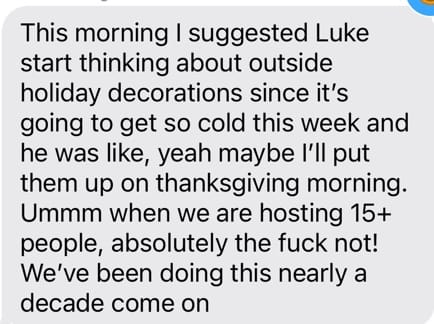
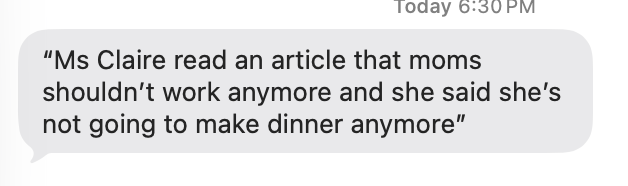
From around this time last year, re: a spouse struggling to understand what is "useful":