DIY storytime: Pull your parenting community together irl
Host something cool people can bring their kids to

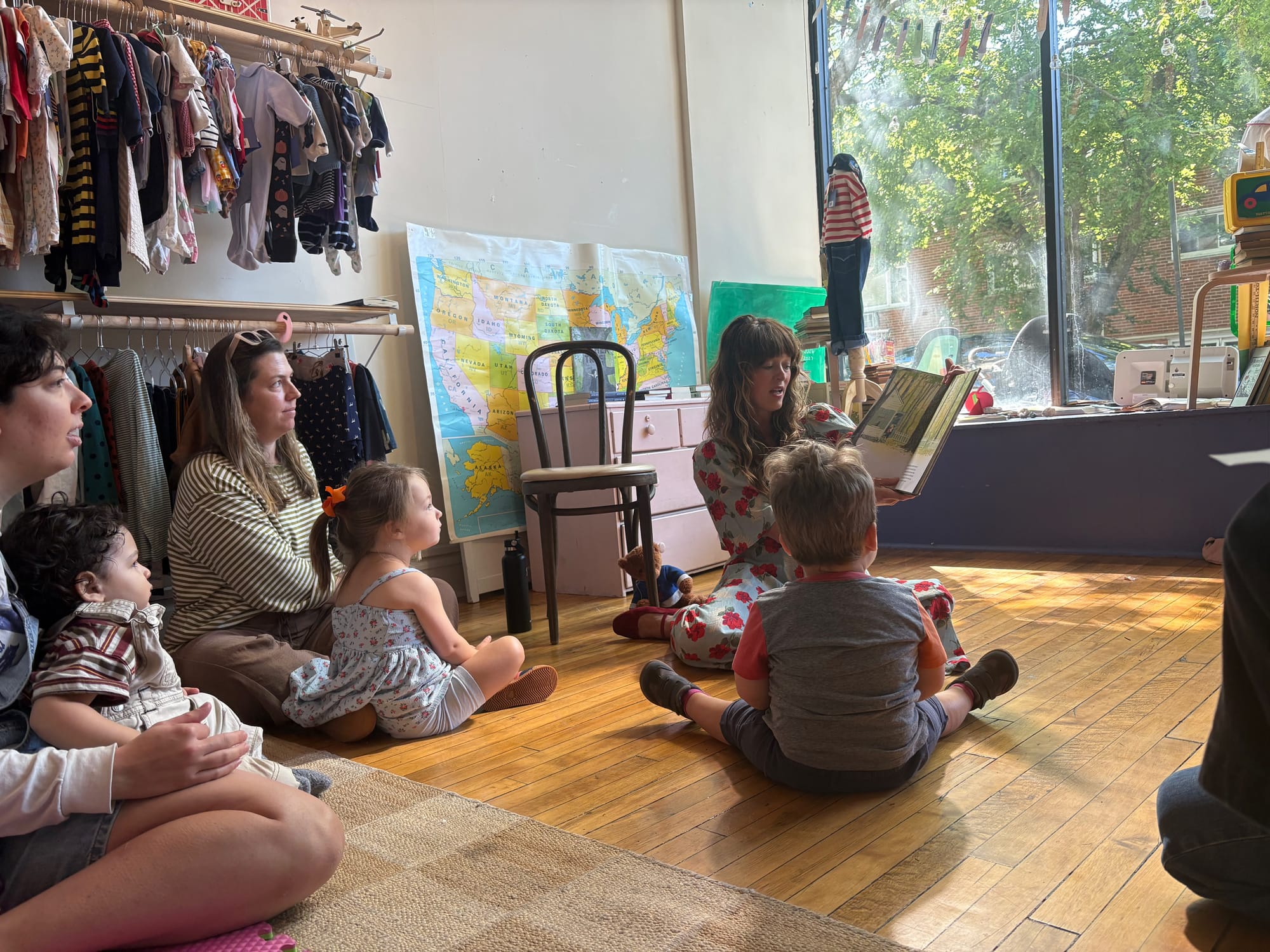
A few months ago I attended the Mom Brain bring-your-own-baby salon at Little Gems, a local children's consignment shop. Kaitlin Teer read from her book, engaged in a group conversation about parenting amid climate anxiety, and ended by reading aloud from a favorite children's book. The maybe 8 or so toddlers there were so well behaved that the moms were accordingly relaxed and serene. (I was later told the kids are not always this easygoing, which made me feel strangely relieved.) It was a wonderful kid-friendly but adult-oriented hang that today's authors tell you how to replicate in your town. —C.Z.
By Nicole Haroutunian, Patricia Zaballos, Erica Stern, Caroline Calvert and Claire Seizovic
Nicole Hartounian: Story Time for Parents and Caregivers began as two stops on my tour for my 2024 book Choose This Now. Rather than sticking to traditional evening events, I planned daytime gatherings — one in San Francisco and one in New York — where people could bring their babies and toddlers for a morning of readings, conversation, and connection. From there, it grew into a series in Queens, with a different writer featured each month.
When Patricia Zaballos caught wind of the idea, she grew it into her own Storytime for Caregivers series at Local Economy in Oakland, CA. After Erica Stern read at the Queens series, she and her collaborators Caroline Calvert and Claire Seizovic developed their idea for Mom Brain Salon at Little Gems in Evanston, IL.
Let’s keep it rolling! We want to share an open-source template for starting a series like ours in your community. We’ll share what works (and doesn’t) for us, and you can take the idea and run.
Origins
N.H.: Back in early 2024, I attended a publicity workshop where the hosts asked, "Where are your readers?" I answered literally: “Ugh, probably stuck at story time.” My book is about early parenthood and its intersections with friendship, and when I envisioned my readers, they were sitting on a library floor, holding a baby in their lap, singing “Zoom Zoom Zoom, Fly Me to the Moon.”
I thought back to my own experience taking my daughter to story times starting when she was four months old. She really loved them, but what did she love? Hearing words, seeing faces, and being in a new environment. At that age, the books didn’t actually need to be geared toward her, and it seemed like a weirdly unacknowledged element of story time that it was actually more for the grown ups, who were just dying for a little adult company.
I started pitching the idea of a “story time” where babies and toddlers were welcome, but the parents and caregivers were centered. The crowd was small but engaged, and it was really thrilling to read a passage from my book about trying to nurse a newborn to an audience that contained mothers nursing newborns. After that, I felt like I had proof of concept. When I got home, I heard from Emily Giglierano, the events coordinator at my local bookstore, Astoria Bookshop, a new mom herself, that she’d love to try out the idea there.
It went really well — an enthusiastic, diverse group of parents and caregivers showed up, just like we dreamed. Afterward, Emily asked if I’d work with her to make it a monthly series, where we’d bring in a different writer each month. We’ve been going for about two and a half years now.
Booking guests
NH: I originally didn’t think I was going to focus only on books that had some sort of parenting / motherhood / birth / caregiving element but came to understand that those were the topics this particular audience was hungry to talk about in this context. We’ve come at it from all different directions—from Jean Hannah Edelman’s memoir Breasts to Ananda Lima’s poetry collection Mother/land to Domenica Ruta’s novel All the Mothers to Jason Diamond’s parenting columns for The Cut—but having some sort of parenting/caregiving throughline has kept conversation engaged and lively.
I’ve had a pretty good track record of enticing authors to read at the series—typically, folks say, “I wish I had this when I had a newborn!”
Patricia Zaballos: In the months when I was searching for a location for my series, author Elissa Strauss (When You Care) — a newsletter acquaintance — said she’d be my first guest, which was so generous and a great boost for my series pitch. Once I’d gotten that start, it was easier to reach out to other authors since my first guests were so well-known and respected.
We get the largest attendance for nonfiction authors like these, but I like to mix up the series with fiction and even poetry. A poet drew the smallest crowd, which enrages me on behalf of poetry, but we had an amazing conversation that day.
Structure
Erica Stern: Our events take place inside a kids consignment shop, so there are plenty of vintage toys available to arrange inside our circle. We’ve noticed that the kids tend to be exceptionally well-behaved – maybe it’s something about a room full of adults intently listening? But we also make clear from the beginning that kids will be kids, and people should feel comfortable feeding or changing their babies, and they shouldn’t worry about kids being loud or disruptive. It’s so rare for caregivers to get their needs met and not feel that they have to apologize for their children.
PZ: While most folks don’t bring babies, something about the presence of the babies changes the conversation. It opens us all up to being vulnerable, quickly! We arrange ourselves in a circle, with blankets and toys in the center for the babies. And rather than saving audience questions for the end, the author reads an excerpt, I ask a few questions and then open it up to the audience. Then we repeat. It becomes more of a conversation between all of us.
NH: “Story Time” happens at the Astoria Bookshop. We arrange chairs in a circle, with a little rug in the middle and some mural paper. I put out a few simple toys and a couple triangle-shaped no-roll crayons—I have more toys in a bag that I don’t put out right away in case someone needs a surprise truck magnet or stacking tower to help them make it through to the end.
I like to be there early to welcome folks and catch their vibes, so I have a sense of how they might want to be engaged. When we have a critical mass, Emily introduces the store, I introduce the series, and then we go around the circle, and everyone introduces themselves (and their kids, if applicable).
Generally, the reader is the last to introduce themselves, and then they segue into their first reading. Then, at the end, they close with a baby book. People either grab one from the shelves at the store or bring one of their favorites from home. This all takes just about an hour — our audience is usually pretty newborn-heavy, so that’s the right amount of time before people start turning into pumpkins.
Inclusivity
NH: Because authors’ experiences, or what their work brings up for folks, can be very specific, I think that makes the whole thing feel, paradoxically, more universal. No one will relate 100% to the reading, but generally everyone can find a connection.
Often conversation flows naturally without my intervention, but sometimes I do jump in to try to find entry points to conversation for caregivers of all different perspectives—like, how could a parent who didn’t carry their baby join in here while we discuss birth stories? How might this conversation sit with a parent who is nonbinary or someone who spent time in the NICU? How might we pull this grandmother’s experiences into the chat? It can be as simple as making space for someone who hasn’t said something to share.
I admit that I didn’t picture nannies as key audience members when I envisioned this series, but when one showed up to our first installment and had the most interesting perspective, I knew I wanted to make sure all kinds of caregivers felt invited and welcome. I changed the title of the series immediately!
PZ: For most events, we usually have a dad or two in the audience, but when Darby Saxbe came to discuss her book Dad Brain, I lost count of how many dads were there, several with kids on their own. It felt like the event was allowing these dads to connect in a different way, and it encouraged me to continue wanting to draw them to events.
Then again, I want everyone to feel welcome at the series and always say so in our announcements. We get a wide range of ages, and some folks aren’t parents. I always center our conversation on parenting/caregiving and community since that’s what this series is all about; still, that framing welcomes everyone into the conversation.
ES: I think a lot about exclusivity in terms of divergent paths to parenthood. I felt on the fringes of “mom activities” when my first was born, because of my birth and NICU experience and the unknowns of my son’s medical status. I really want this to be a place where everyone feels welcome no matter their path.
We’ve started by bringing in writers who have highlighted difficult experiences in parenting, like serious maternal complications during birth and PPD. We also brought in a local writer whose book details her experience as a queer, Black adoptive parent and another novelist who wrote about foster care. I want to make sure to keep looking for the niches we’re missing.
Promotion, proximity and turnover
NH: I have found that, in NYC, our series requires vigorous promotion. One of the challenges is that even the most dedicated and enthusiastic new mom might only be able to come twice before her parental leave ends.
For my work/life schedule, as well as the schedule of the incredible Astoria Bookshop, doing our events one Tuesday morning a month is what makes sense for us. I can imagine a world where we alternate months between a weekday and a weekend morning, though, to be able to include folks who work during the week.
Even for stay-at-home parents, nannies, or those with flexible work schedules, we’ve found that there does come a time when a kid might age out of this series. When kids start to get mobile, we have toys, books, and friendly series hosts to walk around the store with them and put books back on the shelf after they toss them off, while their caregiver gets to participate in the conversation.
But maybe around two or three, kids know that story time is supposed to be about THEM. As it should be! And then, although everyone is welcome, the series becomes a less ideal way for them to spend an hour. When my 9-year-old came with me over the summer during a camp-less week, it was awesome to see her read the book to the babies at the end, but I also didn’t speak as freely about my experience as I might have had her attentive little ears not been there.
Here, folks mostly will not travel outside their immediate neighborhood for this series. If they can’t walk to the bookstore, it feels too far. For us, this is a little tricky promo-wise because Emily and I both live a neighborhood away, which means we don’t have access to the parent FB and What’sApp groups that serve the bookstore; in Queens, folks really rely on these groups. We rely on others to share the info in their networks, and Emily makes sure to flag down anyone who stops into the store with a baby or toddler to invite them back for the series.
CC: I see turnover as an advantage! As Nicole pointed out, there are always new moms desperate for a 55-minute activity with their new baby. It means we have lasting potential as a series and can try out new things or repeat things and not worry about losing our audience. That being said, I’ve been so pleasantly surprised to see how many parents of older kids are still drawn to our events. I do think there is something really lovely about holding a space where new parents can sit alongside more seasoned parents. There is wisdom and perspective that was not in the room, for example, in my milk-stained, sleep-addled postpartum moms group. And despite many or most people being strangers to each other each month, we have found that there is an instant intimacy. The presence of the writer is so critical–by sharing her words, she offers everyone else permission to be vulnerable.
As much as we would love to reach all the parents and caregivers in the Chicago area who are looking for this sort of event, the fact that we mostly draw from Evanston and nearby is valuable for our audience. That hyperlocality allows our attendees to connect with people they are likely to keep running into at the playground and at swim lessons. I know Claire [Seizovic], Erica, and I are running into our attendees all over town and have formed our own friendships with them. I’ve lived in both NYC and Oakland, and Evanston is inherently less transient–it’s a place people move to have their babies, rather than away from, and people arrive, mostly from elsewhere, looking for community.
PZ: I’m super lucky in this regard because my series is held at Local Economy, which sends out a roster of events in a weekly email, for members and non-members alike. Those emails generate a lot of our attendance, I think. So while there’s a lot of turnover with this audience, yes, there are always new folks trying out the series, often without kids.
I also promote on my own social media and make graphics for the writers to share with their audiences. And I made a tiny zine about the series, copies of which I carry around in my wallet. Whenever I see a local adult out with a baby on a weekday, I foist my zine on them and tell them to join us!
ES: We’ve mostly spread the word through social media and posters/postcards in local spaces, and we just started a newsletter to reach people who aren’t on social media. We’re really lucky to have Claire [Seizovic] on our team. She’s got so much expertise in marketing and design, and I think we would not have been half as successful without her. Thanks to Caroline, who writes for our local paper, we’ve had our events listed on their calendar too.
One of the reasons we chose Little Gems as our spot, in addition to it being a bright and welcoming space and the owner, Katie, being a great partner, is that it’s located very close to a train and in a super walkable neighborhood.
I’d also love to tap into the healthcare network more, and for this to be something new parents hear about at their postpartum check-ups or through their lactation consultants. To that end, we’ve talked with a perinatal therapist who was very interested in the series. I think those kinds of connections could be really fruitful.
End credits
Thanks for subscribing to Evil Witches, a newsletter for people who happen to be mothers. If you want to read more about witchy community check out this issue about topics blowing up our collective parenting chats.
This issue is free and open to everyone: please share it with anyone possibly interested and/or boost it on the social media you can still bear to patronize. I also used to produce my own show (Funny Ha Ha at Chicago's Hideout, co-created with author John Green) which was not a kid-friendly event but still a great time. If you have questions on producing an invigorating local event I can add my own two cents.
FYI there is still a coupon for becoming a paid subscriber (or re-upping) at a discount in honor of our bad puppy, from whose beard my husband recently had to wipe human blood after my son had a nosebleed in the backyard and she decided to partake of the puddle.
I'm going to be sending out a very dumb issue soon to paid subscribers only of the cachet of Evil Witches GIFs I'm deleting from my folder after years of not being used for One Witchy Thing, so there is no better time to unlock this priceless content.
One witchy thing